Monday music post, “final exams!11” edition

Hello readers! You may have noticed that I have not updated in a week or so. This is because I have been busy with final exams and such. But I have a lot of cool posts planned for when I am FINISHED with finals, so please bear with me.

Anyway, here are some songs that I have been enjoying as of late. If you have songs that you would like to share, you may leave YouTube links in comments (lyrics are also good!). Or just talk about stuff you’ve been listening to lately, or concerts you’ve seen, or albums you’ve (re)discovered. Whatever — it’s up to you.

First up, here is a suitably intense version of Tori Amos’s “Blood Roses” from 1999 or so (lyrics here):

Next, we have “Here Lies Love” (lyrics; vid is audio-only) by David Byrne and Fatboy Slim with Florence Welch, from the recent concept album of the same name, which is SO AWESOME and you should track down a copy (especially if you like disco, concept albums, and/or female singers):

Finally, an oldie-but-goodie, “Ocean” by the Velvet Underground (lyrics; vid is audio-only):

Tagged , , , , , ,

BADD 2010: “Exhibition”

For Blogging Against Disablism Day this year, I thought I’d share a poem that I wrote a while ago that I haven’t shared until now. I was going to turn it into a spoken-word piece but never got around to it. Better late than never, I suppose.

Exhibition

On my side
side/ways
eyes brain neck
spinning along with
everything else
and I haven’t even been drinking

this is not a workout
and yet, I am sweating
the body over (re)acts
does not know quite how to
respond
and I wish I
could say to
every non-believer, every “skeptic”

everyone who’s ever asked:
what’s wrong with you
why do you walk like that
is something the matter with your foot
what is it
why aren’t you getting better
why isn’t your attitude more positive
why can’t you

almost always accompanied
by one of these:
at least you can walk
at least you’re smart, so you can deal with this
at least you’re not homeless
or starving
or living in a Third World country
you’re luckier than most
how bad could your pain be?
just take some aspirin
stop complaining
why
why
why

for every
you should take vitamins
just work through your pain
I have pain, too
you’re too young to have something
like that
why are you so bitchy
that I hear
I smile a little bit, inside

because: someday
many of these people
will also know
pain

but for now
this is my reality
and I wish you could see it
feel it
for only a minute
and then maybe you’d
think before you
talk at me
or offer meaningless platitudes

every word that exits your mouth

random stranger,
friend of a friend,
asshole on the street who tells me to smile
because it can’t be that bad
every word
means less to me
than I do to you

I’m not your vehicle for
public service
I am not to be used
to show the world

what a great “liberal,” progressive kind person you are
or to be subjected to
your pity
masked as concern
so please step out of
my way
once I can stand, that is
for now—lucky for you
I am confined to vertigo
In my own carpeted purgatory

Tagged , , , , , ,

Go educate yourself (please!)

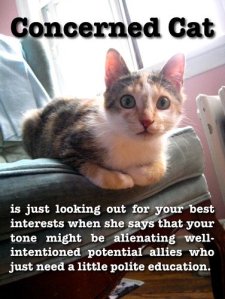
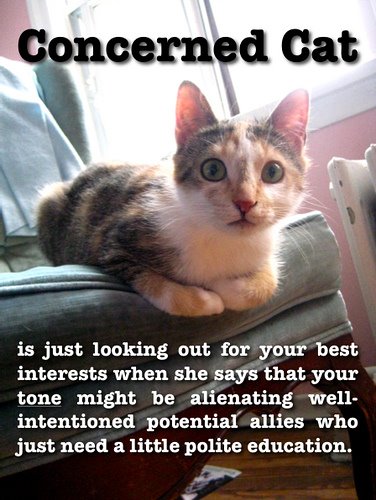
Image description: A shocked-looking cat perches on a chair, staring straight at the camera. Text reads: Concerned cat is just looking out for your best interests when she says that your tone might be alienating well-intentioned potential allies who just need a little polite education.

[Image via Tlönista in this comment thread at Flip Flopping Joy.]

One unfortunately common response to marginalized people saying that there’s a problem is the “Educate me NOW” demand from “well-intentioned allies” who totally mean well, but they just lack education on these issues and so just can’t understand what the fuss is all about.

I am using the following example not to appropriate from the awesome anti-racist work that Jessica Yee and the fabulous Racialicious crew (and countless bloggers around the web!) do on a daily basis, but rather for two specific reasons: 1.) I have already talked about my personal relationship with this oft-used derailing tactic rather extensively, and could probably talk about it ’til I’m blue in the face; 2.) anti-racist activism and disability activism are not completely separate, independent social justice strains — many of us who are involved in these activist projects are, in fact, fighting similar (though NOT completely analogous) battles. For me, claiming an identity as a feminist disability activist has entailed doing my best to fight racism and white privilege alongside fighting for disability rights. This is because disability and race intersect in many, many ways — sort of like how disability and gender, and race and gender, intersect. In other words, this is not just a disability issue, or a feminist issue,  or a trans* issue, or an anti-racist issue; it affects many of us in the social justice blogosphere, if in differing ways.

The “educate me now because I want to learn, marginalized person!” response played out, yet again, fairly recently in the comments to a post on Bitch authored by Indigenous activist and writer Jessica Yee. Jessica had written a post on white hipster/hippie appropriation of native dress and why it’s not only ridiculous, but racist. Makes sense, right? (If it doesn’t, you might be at the wrong blog. Or go read this. I don’t know.) Overall, this piece seems like it would fit right in on a website for a magazine that is dedicated to showcasing “feminist response[s] to pop culture.”

And then the comments started rolling in, and so did the “but you have a responsibility to educate people who mean well!” trope:

I’m sure this is in fact extremely annoying. However, you might consider that when people bring that up, they’re not saying, “Hey I’m just like you and I totally understand what you deal with,” they’re trying to make a connection and learn something. Ignorant people are a pain in the neck, but they’re mostly not trying to be ignorant on purpose.

I‘m merely suggesting that if this is a cause you deem worthy of championing, then you should have a prepared source of information for them—be it this blog, book titles, or documentaries. Encourage them to learn more about THEIR history and perhaps you’ll draw a new soldier to your army.

It seems somewhat contradictory to put stickers on your laptop that indicate a Mohawk heritage and then rudely dismiss a stranger who expresses an interest in your advertisement. Perhaps a better way to accomplish your agenda (whatever it is) would be to engage in polite and open-minded conversation with those who mistake your stickers for an invitation.

Thea Lim at Racialicious pretty much nailed it in her recent post on what went down, entitled “Some Basic Racist Ideas and some Rebuttals, & Why We Exist” (which I highly recommend that you read in full, by the way). An excerpt:

This kind of hey-let-me-help-you-achieve-your-goal-by-suggesting-you-be-more-radio-friendly response totally misunderstands (and appears disinterested) in the anti-racist project, because it assumes that anti-racism is all about convincing white people to be nice to people of colour.   In other words, it assumes that anti-racism revolves around white folks.  Like everything else in the world.

Anti-racism and people of colour organizing is not about being friendly, being appealing, or educating white folks. While individual anti-racist activists may take those tacks to achieve their goals, the point of anti-racism is to be for people of colour.

I completely agree with Thea here — and I believe something similar applies to disability activism. That is: Those of us with disabilities are not here to make abled people feel comfortable, to hold their hands as they have a Very Special Learning Experience (most often, it seems, at our expense), or to make them feel good about themselves. I, personally, don’t care how “good” your intentions are, or that you reallllllly wanna learn, or if you think I’m being mean by not dropping everything to educate you when you demand it.  While I definitely don’t want to speak for Jessica, Thea, or any of the Racialicious contributors — or for people of color who do anti-racist work — I suspect that they may feel similarly about white people who come into PoC, WoC or other anti-racist spaces and demand that whoever is doing the activist work must halt whatever discussion is going on and educate them, now, because they are good “liberal” white people and have such good intentions, and you PoC want white people like me as allies, right? And if you don’t drop everything and rush over to educate me, well, you’re just a big meanie who must not want my support after all (such “support” is often conditional, and based upon whether the marginalized person can make the non-marginalized feel comfortable at all times), or you just want an excuse to be racist toward white people! Or some other ridiculous thing.

For me personally, the willingness that I “should” have to help well-meaning folks learn is also an energy issue. I am a person with disabilities, several of which I have written about at length on this website — and one of which is a pain condition subject to flare-ups. Thus, I have to manage my time and energy extremely carefully. Having to explain basic concepts over and over again to strangers on the internet because they’ve deigned to tell me that they “want” to learn — and some of whom may think, by extension, that they are somehow entitled to my time and energy — takes work. Writing takes work; additionally, a lot of bloggers do the blogging and responding to comments thing for free, on their own time.

And sometimes, those of us with conditions that intersect with our ability to do this work end up burnt out, frustrated, or we lose our patience. Though these end results are often nothing personal, they might read like it, and we end up paying the price energy-wise only to have that person who realllllly wanted to learn petultantly respond with something like, “You must not want to educate me, then, if you’re not up to answering all of my questions!” and leaving in a huff. But they reallllly want to learn. . . that is, if someone else does the brunt of the work for them and/or gives them good-ally cookies for just wanting to be educated about all this social justice stuff. Merely wanting is not enough; you have to actually follow through for your good intentions to matter.

There is, thankfully, a solution to this problem: those people who say, or comment, that they realllly want to learn must take responsibility for their own learning. There are several ways that this can be accomplished, among them lurking on blogs for a while before one starts commenting, reading a site’s archives (and most sites have them!), picking up a book (or two), reading articles online or off. Certainly, there are a lot of things that are privileged about this assertion; of course, not everyone has the time to read about social justice, lurk on blogs, or take similar steps. But what is also privileged is the putting the responsibility for your own 101-type education onto someone else — someone who might not have all of the energy, time and patience that you might.
Tagged , , , , , , ,

Balancing Act

[Cross-posted from my Tumblr, which features a lot of things–like, for example, pictures of puppies and YouTube videos of Tori Amos–other than blog posts. Edited for clarity and bizarre sentence syntax, and expanded a little bit. Please try to follow the comments policy.]

This is probably going to sound scattered and weird and nonsensical in parts (I am supertired and tried to take a nap earlier, which did not happen). I would not be surprised if I lost some readers over this. I may regret posting this later. However: It’s important, and it is worth noting that this post is not meant to address one person or group of people in particular, because there have been, actually, several fairly recent incidents (again, spoiler alert, SEVERAL!) that have inspired this post.

I have a major Thing with being told that I am excluding other people, letting them down, and/or not taking them and their needs into consideration enough, both because I know from experience what it is like to be actively excluded in a painful, gross manner (thank you, mainstream U.S. feminism!) and because I have some Personal Issues with codependency (which used to be a hell of a lot worse). And yes, telling people that that they are being exclusionary/inconsiderate can be very useful at times, so my point is not to say that you should never tell anyone that they are excluding you (I mean, look at what happened with the Evelyn Evelyn thing in part because of my inability to shut up and my general verbosity!). And I know it’s going to sound like I am making it All About Me, which I do not want to do, but there are times when you have to put things on the table to make them clear, or at least intelligible. Or something. I don’t talk about my history of major codependency issues very publicly, mostly because I am concerned that a.) it will sound whiny or like I am trying to excuse the times that I have screwed up (of which there have been MANY, by the way, and since I am not perfect, these times will continue!) or b.) showing more vulnerability than I have in the past will just give trolls more ammo.

I just don’t know how to balance my own need for a “safe space” as a disabled woman on the internet with demands that I cover x issue, that I need to work more on y,  people saying that I am not focusing on the right things, or not working hard enough or jumping high and gleefully enough through some rather arbitrary hoops that have been put up, or that I am excluding people. But sometimes there are comments that I do not let through because they make me feel…just off, or they make my pulse go up a notch (is that a trigger sign?). This is not anyone’s fault, of course. I am inclined to blame myself and say stop it, you are being oversensitive. And feedback is something that I find useful. But I have spent years of my life doing many, many things and taking the shit for other people without also considering myself or taking care of myself, and it did not get me much other than chronic pain (I don’t know for a fact that my pain has been caused by this alone, but I’m pretty sure it was a contributing factor).

Here’s my major point: There is more than one way to be a feminist. There is more than one way to be a PWD. In one area of my life, I am attempting to (though not succeeding?) help make a space for as many people as possible while also doing my best. I know that neither intent nor effort “excuse” in any way what actually comes out or happens. There’s got to be a method that respects the many disabilities and the many feminisms out there without placing an unfair burden on any of the parties involved. I don’t know what that method is. Things will collide. Misunderstandings will occur. I am not adverse to this, but what I am adverse to are insinuations that I am not working hard enough, or that I am letting our community down (please remember, I am just one person!), among other things.

Other major point: You don’t know. There are a lot of things that I do not talk about on my blog, for various reasons (including, ya know, privacy reasons). There are a lot of things that you don’t know. There are a lot of facets of my experience that you cannot or do not see.

I am working. You might not just be able to see it, or I may not choose to give you all of the details.

I am listening. Maybe a little too hard.

I am trying to take other peoples’ needs into consideration and work things out, more than they will ever know.

And it’s fucking trite and cliched to say this, but: I am a person, too.

Tagged , , , , , , ,

Why SF’s Proposed Sit/Lie Laws Are a Terrible Idea

[Note: Please read the comments policy carefully before commenting.]

In San Francisco currently, there is something of a debate brewing about Mayor Newsom’s proposed sit/lie laws, which would make it illegal for anyone to sit or lie on any public curb or street in San Francisco (with a couple of exceptions).

The intersections with disability here are rather clear. For one thing, there are some intersections between homelessness and disability, because some homeless people are, for example, mentally ill or have disabling physical problems. Do either of these things make them unworthy of compassion, or not human? Of course not, but from the way this proposed ordinance is designed, it is, on a very basic level, criminalizing homelessness even more than it is already criminalized (not to mention socially stigmatized), while taking extra “common sense” steps to avoid citing non-homeless people for an offense. Observe the following response to concerns that SF police would begin to crack down on non-homeless people were the laws to go into effect:

During a heated, five-hour Board of Supervisors public safety committee hearing on the issue Monday, Adachi showed photographs of behavior that would be illegal under Newsom’s proposed law: a well-heeled tourist sitting on her luggage as she waits for a cab, a little boy sitting on a sidewalk clutching his skateboard, and tourists sitting on a curb and gazing up at the sights.

Assistant Police Chief Kevin Cashman said all of those people would be warned first to move and that none of them would probably receive a citation.

“Obviously common sense is going to be part of the training with enforcement of this statute,” he said at the hearing.

Ah, yes, “common sense.” Common sense, apparently, still makes the further stigmatization of homeless people de rigeur. Because apparently, they don’t deserve to sit down in public, unlike “well-heeled” tourists and neighborhood residents. I wonder what the response to a person with disabilities — tourist or not — needing to sit down on a public street might be? Someone waiting for an ambulance? While that is approaching a bit of a slippery slope argument (which I generally like to avoid), it is worth considering, simply because “common sense” will mean different things to different people — those whose job it is to enforce the statute included.

Also interesting is the framing of this ordinance in terms of concern for children. From one of the SF Gate articles:

Newsom, who bought a home in the Haight recently, was convinced to support an ordinance after walking along Haight Street with his infant daughter and seeing someone smoking crack and blocking the entrance of a business.

Certainly, children need to be protected from dangerous situations or potentially dangerous situations, but is an ordinance that criminalizes the poor and homeless — not all of whom are recreational drug users or addicts — really the way to do it?

Additionally, nowhere have I seen any plan to increase the number of homeless shelters or services for homeless people attached to this ordinance. The implicit message behind these proposed sit/lie laws seems clear: It’s too bad you’re homeless, but don’t you dare be homeless on our streets, because it might make our city look bad. Oh, and you certainly shouldn’t expect the city to help you not be homeless — even after it cites you for breaking the sit/lie law.

(Cross-posted at FWD/Feminists With Disabilities)

Tagged , , , , , , , ,

Important!

I have a guest post up at the amazing blog Tiger Beatdown! This is exciting, at least for me! Please go read it (even though it is kind of long)!

Tagged , , ,

Today in “Missing the point, rather spectacularly”

From the mod queue on this post, which is almost a month old:

Really! So limiting “hate” speech is OK? This is a great concept until the opposition gains power and limits your speech as “hate” speech. Who ever your opposition is. Whether you like lesbians or hate lesbians, like straights hate straights, like the left hate the left, like white people hate white people, like black people hate black people, this is s slippery slope. When one becomes egocentric and can only tolerate their own point of view, then you they have joined an elite group that includes: Nazi’s (killed millions), Soviet communists (killed millions), Chinese communists (killed millions), KKK (killed thousands). Your hatred of hate speech as you define it, is no different. The message is this, be careful in imposing your will on others, it sometimes turns out badly!

I read this comment and I think, “This person did not read the damn post, because nowhere did I say that speech should be limited.” Calling people out for saying bigoted shit and/or when they jump to “free speech means I can say whatever I want, without getting called on it” is not the same thing as legislating what can and cannot be said.  Anyone with a basic understanding of what free speech actually means, and, uh, logic knows this. Also, LOL at slippery slope argument, and putting words in my mouth.

Reading comprehension: get you some.

Why Roxy Music is awesome (as is Bryan Ferry)

This is part one of a two-part post on Roxy Music and Bryan Ferry, and why they are fabulous. The songs here are some of my favorites, and this post is intended to give readers/listeners a little preview as to this band’s total awesomeness. Take it away, random YouTube users!

“In Every Dream Home a Heartache” from For Your Pleasure (1972): This, unequivocally, is the song that made me a Roxy fan. There are so many layers here — like a delicious sandwich, if you will pardon the metaphor — and, more importantly, you do not have to know jack shit about music, songwriting, or composition to realize this. The lyrics, I think, essentially predicted suburbia’s dead end and/or souless McMansion-white-picket-fence-with-traditonal-heterosexual-marriage-big-SUV-and-2.5-children before those things even existed as specific Western cultural artifacts. I am sure that there is some sort of Technocultural Studies dissertation that could be written about this song (perhaps with a snappy, oh-so-postmodern title to go along with it?), but my relentless fannish devotion (among other things) prevents me from even considering taking on such a project.

“Mother of Pearl” from Stranded (1973): While it’s not my favorite Roxy song, it is a classic, and a good introduction to the band’s overall style.

“The Thrill of it All” from Country Life (1974): Ignore the retrogradely sexist cover art — and also dig the weirdness of that command coming from someone who has a degree in Women’s and Gender Studies (namely me). Country Life is my favorite Roxy album other than For Your Pleasure, and admitting this probably counts as blasphemy in some circles (as it was the group’s first album after Brian Eno left). But admit it, I must, because the album is so freaking good. And one verse (somewhat indirectly) alludes to a rather famous Dorothy Parker poem, so what’s not to love?

“Casanova” from Country Life (1974): This is my favorite Roxy song of all time. I can’t quite put into words how fantastic it is in every way possible; thus, I urge you to listen. The lyrics are brilliant; anyone who’s been graphically catcalled by gross dudes or unskillfully hit on by some creepy, drunken fraternity trust-fundie asshat at a bar will be able to relate. I would like to think that this is Bryan Ferry’s message to other dudes in which he says, “Guys, stop acting like such monkeys and/or thinking you’re totally suave, because you are actually the opposite of suave,” but my interpretation could be way off.

“Same Old Scene” from Flesh + Blood (1980): It’s from the ’80s! Otherwise known as that decade where some mostly drugged-out rich people made a lot of terrible music, and which is mostly invoked when hipsters want to be nostalgic for crap that they were too young to remember as crap! But please, do not worry, because “Same Old Scene” is an example of something good that came from that decade.

And if, after all of that, you need evidence that Bryan Ferry’s “still got it,” look no further than his many Bob Dylan covers, including “Don’t Think Twice, It’s Alright” (performance is in the first two minutes or so of the clip, and the rest consists of him talking about his album of Dylan covers, which is also interesting):

Better than the original, I think (again, blasphemy in certain circles). But then again, I am one of those weirdos who really likes his cover of “A Hard Rain’s a-Gonna Fall,” (link goes to an absolutely incredible short film of Ferry’s version that must be seen to be believed), mostly because that cover is so bizarre that it ends up being wildly entertaining.

That concludes part one of my Roxy Music/Bryan Ferry post; part two will be posted soon.

Tagged , , , , , , ,

Quote of the Day

Cultural criticism clears a space in which we can stand back and survey a scene that we are not normally engaged in living in, not thinking about. In that space, we can function not merely as consumers of cultural pleasures and rewards but also as phenomenologists and diagnosticians of those pleasures and rewards.

–Susan Bordo, from the Introduction to Twilight Zones: The Hidden Life of Cultural Images From Plato to O.J. (1997)

Tagged , , , , ,

Blast From the Past: This is Not My Type of Feminism

[Important note: New feature! “Blast From the Past” will feature past posts from my old blog that I think are worthy of inclusion on this one, mostly because I like ’em. This post is from May 2009, so it’s a bit old in blog-time, but I think most of the points made are still (sadly) relevant. I’ve changed some of the wording for clarification purposes.]

There are days when I question whether feminism, as a whole, is welcoming to people like me. Or to people who are not exactly like me, but are still part of groups that have historically been ignored, erased, marginalized, or plundered by mainstream feminism.

This absolute trainwreck of a “discussion”–on mental illness–happened over two weeks ago at Feministe, and I’m still thinking about it. Many (though not all) of the comments on that post are horrific displays of ableist tripe.

I do not understand why some find it so haaaaaard to grasp that disability and ableism are feminist issues, or that disability rights and the rights of people of all genders are connected; I find it equally difficult to understand why some are so dedicated to holding on to the last vestiges of their privilege, even as they give lip service to things like “inclusion” and “diversity.” Neither term holds meaning when used by a certain type “good” mainstream liberal/feminist/et al to describe just how awesome and progressive they themselves are; oftentimes, these words are used to make those in the mainstream feel better about themselves, their privilege(s), and their biases–some of which they just cannot let go.

Again and again, I see comments in several places online that suggest that disabled and other marginalized people, and their experiences, are only good for two things: enabling the “growth and development” of mainstream feminists, and providing abstract (at least to those who have that privilege) discussion fodder that allows various “concerned” fems to do their thing without questioning their own privilege. Both of these have the effect of depoliticizing any radical potential that those who are NOT het white cis upper-middle class able-bodied mentally “healthy” feminists may bring to the table. In a way, it’s kind of like using the ideas of radical women of colorwithout referencing where these ideas come from!–to make a point about your wedding, of all things.

It fucking hurts.

Tagged , , , , , , , , , , , ,