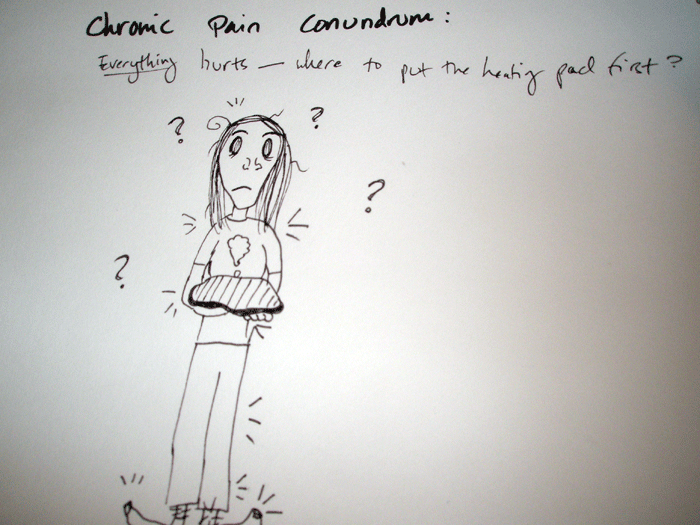
[Image description: Line drawing of Annaham holding a hot heating pad in her hands and looking confused as question marks surround her. Text: “Chronic pain conundrum: Everything hurts — where to put the heating pad first?”]
[Image description: Line drawing of Annaham holding a hot heating pad in her hands and looking confused as question marks surround her. Text: “Chronic pain conundrum: Everything hurts — where to put the heating pad first?”]

[Description: Black and white image of musicians Jesse Sykes and Phil Wandscher.] (Image courtesy of jessesykes.com)
So, as probably evidenced by the existence of this tag on my Tumblr, I am a huge fan of the alt-country band Jesse Sykes and the Sweet Hereafter. I have seen them perform live several times (five or six, by now? I’ve stopped keeping track, truth be told); I’ve also met Jesse several times, and she seems like a pretty awesome lady who also makes amazing music (that sound you’re hearing would be my fangirlish squeal; my friend and occasional concert buddy Amy can attest to the intensity of my squeeage).
The band’s current lineup consists of Jesse Sykes (lead vocals/guitar), Phil Wandscher (guitar/vocals), Bill Herzog (bass/vocals), and Eric Eagle (drums/vocals). Headquartered in Seattle, Washington, the Sweet Hereafter’s musical style is distinguished by layers of eerie (yet catchy!) melody ensconced in drifting wisps of sound that seems — at least from a metaphorical standpoint — akin in some ways to the layer of misty fog that is a near-constant in the Pacific Northwest.
From a less metaphorical standpoint, however, the music of Jesse Sykes and the Sweet Hereafter is country — or, more accurately, alt-country — for people who wish that country music was less poppy. If you’ve ever wanted to hear more late ’60s- early ’70s psychedelia influence in alt-country music, you will probably find something to appreciate in this band’s oeuvre. Or perhaps you’re one of those folks who would listen to more acid-rock/psychedelic material, but you tend to enjoy great musicianship and vocal skills in addition to seemingly endless guitar solos. Jesse Sykes and the Sweet Hereafter are a perfectly down-tempo combo of psychedelic rock, alt-country (complete with nicely utilized slide guitars), and atmospheric chill-out music. To some, this may appear to be (or sound like) an odd formula, but in the hands of these talented musicians, it is a successful one; they consistently manage to merge the otherworldly and dream-like with the down-home, and the results are usually spectacular.
Okay, onto the actual music! The selection of their stuff available on YouTube is decent (many of the songs I wanted to include here were not on YouTube); accordingly, I’ve limited the songs posted here to high-quality live performances and audio-only tracks. Lyrics for most of these songs are available at Always On the Run.
From Reckless Burning (2002):
The title track:
Lonely Still:
Doralee (solo performance circa 2009, for French webzine Le Cargo):
From Oh, My Girl (2004):
Title track:
The Dreaming Dead (which you may have heard on HBO’s True Blood):
Grow a New Heart (Note: It’s hard for me to pick a favorite of theirs, but this one is consistently near the top of the list!):
From Like, Love, Lust and the Open Halls of the Soul (2007):
LLL (live at the No Depression Festival, 2009):
The Air is Thin (official video):
Spectral Beings:
Station Grey (live in Amsterdam, 2008):
From the Gentleness of Nothing EP (2007):
Be it Me or Be it None (also for Le Cargo sessions):
Gentleness of Nothing (peculiar pleasure):
And one non-album track, “The Sinking Belle” with BORIS and Sunn0))):
The band’s latest album, Marble Son, is currently out in Europe and France, and is due to be released on July 26 in North America. One of the tracks from the forthcoming release, entitled “Ceiling’s High,” is below:
If you’d like some mp3s to download instead of waiting for all of these YouTube videos to load, the band’s now-former label, Barsuk, has a couple of songs available for free, as does the live music website Daytrotter.com; their official website also has a few songs available for streaming (click “Listen” on the menu at left).

[Image of Annaham, a young white woman with dark blond hair (worn in a bun) and blue eyes, sitting on a couch, wearing bright blue/teal eyeshadow that is exaggeratedly painted above her eyelids, nude-pink lipstick, and an orange scarf with white polka dots. She is looking up at something above the frame with a bemused expression.]
YET ANOTHER RIDICULOUS PHOTO OF YOURS TRULY, WITH MAKEUP.
This time, it’s Urban Decay’s Painkiller eyeshadow, available in the Show Pony Shadow Box (an excellent palette that has some good neutrals AND some lovely brighter colors; review from Temptalia here); Peace (from the Deluxe Shadow line, of which there is an entire palette, which I highly recommend if you want to try a lot of bright colors but are on a budget) is a fairly close dupe, although it’s a little more true blue than Painkiller. Lipstick (not really visible in this photo, but oh well) is MAC’s Sheen Supreme in Impressive (reviews and swatches); it’s a nice pink-nude color with a texture that is quite moisturizing on the lips, if you go for that sort of thing. Many lipsticks tend to be too drying for my lips, which probably explains why I have a lip gloss collection in the double-digits and (maybe) five or six lipsticks in total.
There are some people who believe that bright eyeshadows draw too much attention to the wearer and so should not be used, or should be used sparingly. You can probably guess why I think that is a load of hooey. This isn’t true for everybody, of course, but if some jackass is going to stare at me because I am moving through the world while being disabled and a woman and such, I might as well go out on some days with my bright eyeshadow on because it enhances something that I like about my appearance (that would be my eyes, for the curious), and I am thus less likely to care if some douche thinks I shouldn’t be out in public, or wants to ask me about my cane, or something.
Does this work every time? Nope. But some days, it keeps me from going over the edge or down a spiral of awful self-esteem (which has been a problem ever since I can remember) and, at times, very actively disliking myself. Sometimes, it’s the little things that get you through. Not always, but sometimes. I have had issues with my appearance for a long time, and wearing colorful makeup every so often has (weirdly) helped me move past some of these issues, or at least has shown me that I can (and do, even when I’m not wearing makeup) look fabulous. I was convinced for a long time that my face was weird-looking. Thanks in part to experimenting with bright makeup, I don’t feel that way anymore. I may not be conventionally “attractive,” but that is totally cool with me.
I probably should be wearing eyeliner or mascara here to make things look more “finished,” but it was pretty hot outside and I wanted to minimize time spent getting the makeup off my face after I was finished wearing it (and when I wash makeup off, it tends to run down the side of my goddamn face as well. AWESOME).
[Originally posted on Tumblr]
I haven’t been able to put together a post for Blogging Against Disablism Day (BADD) this year due to other commitments, but be sure to go check out the list of this year’s posts, compiled by Goldfish at Diary of a Goldfish. As with other years, I am sure that there will be many excellent and thought-provoking posts!
I’ve contributed to BADD in the past, so now may be as good a time as any to drop some links: a poem, a bingo card, the first bingo card (cross-posted at FWD; not for BADD, but perhaps necessary for context of card #2).

[Image of Annaham, a young woman with dark blond hair (worn in a bun) and blue eyes, sitting on a couch and pursing her lips in an exaggerated manner. She wears a black t-shirt and fuchsia lipstick.]
So, sometimes I like to wear makeup. This is not exactly news, I know.
In this photo, I am wearing Urban Decay’s Trainwreck lipstick, which is BRIGHT FUCHSIA, and it has glitter in it. I should note that I am not wearing any other makeup here, hence the wonky left eyebrow and skin unevenness. After I first bought this lipstick, I was kind of afraid to wear it in public because it is SO BRIGHT on my lips. I feel like someone, at some point, may come up to me and say, “That lipstick is too bright for your lips! Wear something more neutral.” (This may or may not be followed by an invasive question about my cane, because people commenting on someone’s appearance tend to pull that kind of shit, at least in my experience.)
To which I say: This is the only bright lipstick shade that I own, and I usually have issues with my lips in that I think they are too big and/or “out there.” That feeling seems to take a backseat when I wear this lipstick. Sometimes I just want to say, “MY LIPS ARE BIG AND THEY ARE COVERED IN BRIGHT FUCHSIA LIPSTICK, DAMMIT. OH, AND I WALK WITH A CANE BECAUSE I HAVE A DISABILITY, SO YOU CAN TAKE YOUR JUDGMENT AND SHOVE IT.”
I am not sure what walking with a cane and wearing bright lipstick have to do with each other. Maybe they have nothing to do with each other. But I will apologize for neither, and, in some way, I may be further inching toward accepting myself just a little more.
[Originally posted on my Tumblr]

[Description: Line drawing of a nude young woman with shoulder-length dark hair and hairy legs; she stands with arms extended. She has a pained expression on her face, and arrows of varying sizes pierce her body. Both her chest and crotch areas are covered with large “X” marks.]

[Description: Cover of Charlotte Martin’s album Dancing on Needles, which depicts Martin, shown in profile, in some sort of woodsy outdoor environment. She appears to be looking up at something out-of-frame.]
Charlotte Martin: Dancing on Needles (1 Feb 2011); Test-Drive Records (available via iTunes, Amazon, and through the artist’s website)
When I first started hearing about Charlotte Martin’s album Dancing on Needles in some preliminary press coverage last year, I was both excited to hear the album and more than a bit skeptical when it came to the tone of some of the coverage. Some of this coverage focused on the fact that Martin’s new record had been inspired by her battle with severe chronic nerve pain, and the apparent “happy ending” to her story; as someone with chronic pain, it seems to me that this type of narrative is often trotted out in order to reassure the audience that the subject is “better now”–even though that’s not the way it works out for most folks with chronic pain. For many of us who deal with chronic pain issues, there is no “ending,” happy or not; chronic pain is, by its very definition, unending. Oddly, many narratives of disability in popular culture propose an end or accord some sort of “inspirational” power to a disabling health condition, often meant to reassure many nondisabled folks’ existing attitudes about disability.
Popular culture, at least in the United States, tends to engage with disability in ways that are both extremely limited and highly specific. There are a number of well-worn tropes about disability and ability that popular culture drags out time and time again, namely: Disability is always tragic and awful. Illness and/or disability can be turned into a 100% positive “opportunity” to discover what’s really important in life, or to teach the person with the disability or illness–and the nondisabled people around them–a crucial life lesson that they never would have learned if not for their illness/disability. Disabled people are freakish, abnormal, scary, and are thus not deserving of basic human treatment; they deserve only pity, charity, or to be gawked at. They are constantly angry about their lot in life (think of House, for example–even with all of the complexities that make him such an interesting character). They are just jealous of people who are normal because they themselves are not normal. People with disabilities can “overcome” their limitations, but only by doing amazing things that, above all, serve to inspire nondisabled people (what’s up, Supercrip)!
Dancing on Needles, thankfully, does none of the above. If you’re looking for a completely inspirational record, or one with easy answers, you may want to look elsewhere.
Charlotte Martin has made quite a few albums. I have heard almost all of them (exception: Piano Trees, which apparently was a tour-exclusive album and one that I haven’t been able to track down). They are all spectacular in their own ways, but this one might be my favorite, and not just because many of the songs are about dealing with chronic pain and the uncertainties that it poses. The entire album is a complex, layered work about dealing with chronic pain and its uncertainties. We have all seen works of art about disability that rely on one or more of the tropes and narratives listed above. To which I say, YAWN, because most of the aforementioned tropes and themes get excruciatingly boring after a while (not to mention overused), and then you have a lot of people thinking that those tropes are the only ways to engage with disability/ability in creative work, simply because those are the stories that have been used so often. Dancing on Needles does not fit into any of those narratives quite so easily, at least not with lyrics such as:
My reflection is a woman I do not know/Thunderclouding ’cause she hasn’t got far to go/I haven’t got far to go (from “Any Minute Now”)
Or:
Great ideas/God, we had great ideas/Didn’t know this could happen to me/Struggling/To see the meaning in all of the meaningless/I wasted when I had you here (from “Life Vest”)
Of course, there are multiple ways to interpret the album’s lyrics, including those excerpted above, but since the album has been described repeatedly in articles and press materials as being inspired, in part, by Charlotte’s recent experiences with chronic pain, I’d be pretty surprised if at least some of the lyrics did not refer to it at all. Even if the lyrics are not straightforwardly about chronic pain throughout, all of the songs on this album add up to an incredibly interesting, rewarding record that seems, more generally, to be about life changes and the uncertainties that they pose. I’d argue (mostly from personal experience!) that chronic pain, and living with pain, can be and often is a major life change. Learning to live with pain entails some sort of change, usually; Dancing on Needles is a stunning example of how great art, and great music, can spring from tremendous life changes.
Musically, it is also a great pop album. I hope that this will not be the only pop record that features a first-person experience of disabling chronic pain as one of its main themes. Of course, it’s probably not going to completely revolutionize pop music and that genre’s treatment of disability, because it is one album. The important thing is that this album is a starting point, and one that has set the bar pretty high at that.
So, my Yorkshire Terrier, Winston, is a critter about whom I have written before, most notably on FWD. I have described his odd habits before, but in order to get the true Winnie experience, it is best to view it for oneself. Below are some videos that my partner, Liam, recorded that feature Winston’s weirder behaviors. The first two are funnier in HD or in one of YouTube’s high-quality formats.
Here is one that features Winston panting (loudly!), after a lengthy walk on a warm day (the thing on the right is my foot):
Spinning his face into the carpet (exactly what it sounds like). The best part, I think, is at the end, when he realizes that someone is watching:
Rubbing himself on our couch and making bizarre noises for no discernible reason at all:
I’m sure Winston will have many more YouTube vids to come, but for now, the above will have to do!
What I imagine my toes might say, if they could talk. As usual, click for large.
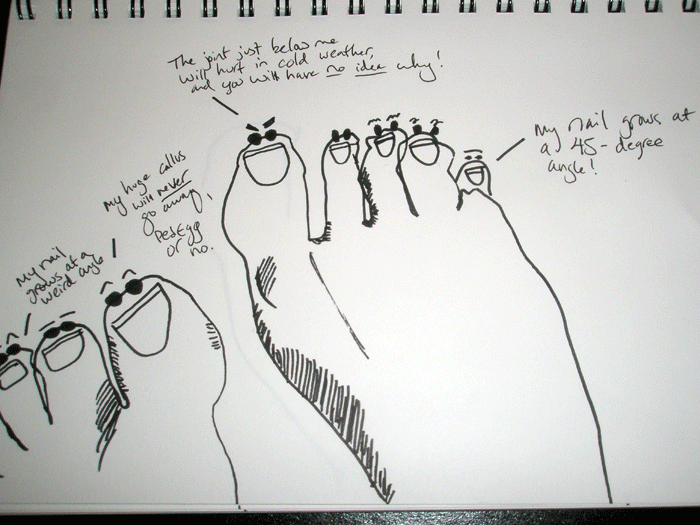
[Description: Black and white line drawing of two feet; all of the toes have gleeful facial expressions, and a few of them have dialogue lines. Third left toe: “My nail grows at a weird angle”; Big left toe: “My large calluses will never go away, Ped Egg or no”; Big right toe: “The joint just below me will hurt in cold weather, and you will have no idea why!”; Smallest left toe: “My nail grows at a 45-degree angle!”]
The reddish reflection here is from the sweatshirt I was wearing when I photographed this piece, and for some ungodly reason, I liked the effect enough to post the photo. As usual, click for a larger version.

[Description: Black and white painting of a bunch of random splotches, in the midst of which is a woman who stands uncomfortably while holding her right arm out to the side. Her arms and hands are composed of large, random shapes, her legs are thick black lines, and her feet are rectangles. She stares directly at the viewer, and does not appear to have a mouth.]
 Anna Hamilton | Writer