
[Description: Line drawing of a woman in a bed, sitting up against the pillows as her eyes—popping out of her head—focus on her body parts, which have detached from their sockets and are floating around the room.]
[Description: Line drawing of a woman in a bed, sitting up against the pillows as her eyes—popping out of her head—focus on her body parts, which have detached from their sockets and are floating around the room.]
Director Matthew Galkin’s documentary Kevorkian (aired on HBO on June 28th; also available on YouTube) is one of those documentaries that I felt nervous about watching, mostly because I was extremely skeptical that it would be anything other than a massive apologia for the man colloquially known as “Dr. Death” in the U.S. news media and among much of the North American public. I was also concerned that my own complicated views on physician-assisted suicide would impact my feelings on whether this documentary was worth the time and emotional energy spent watching it. Like many documentaries, it is a difficult film to watch. It is not uplifting by any means. Parts of it are brutal. Parts of it are frightening. That said, however, I am ultimately glad that I watched this film — not because it “humanizes” Jack Kevorkian or acts as an apologia, but because it deftly explores issues of ethics, law, the power of the media, and legacy.
The entire film is framed by Kevorkian’s ill-fated 2008 bid for a congressional seat representing the state of Michigan — his platform, as the film shows it, leans heavily on the Ninth Amendment — but his congressional hopes are not the most interesting or thought-provoking part of the film. Almost paradoxically, the most interesting part of this documentary is the fact that Kevorkian does a pretty excellent job of not coming across as particularly sympathetic, something that a viewer might not glean from the film’s trailer.
Here, Kevorkian comes off as one majorly self-aggrandizing guy, and it seems like the director does not have to work very hard to make viewers see that Kevorkian can be difficult to deal with. He often seems so enamored of his own ideas, and his own legacy, that he focuses on these things to the detriment of his friends and allies — and, ultimately, his cause. This becomes most clear in one sequence late in the film, where a longtime supporter of Kevorkian’s publicly disagrees with him at a small town hall-style meeting; Kevorkian responds not by answering the man’s questions regarding the Ninth Amendment, civilly discussing his differences of opinion or why he feels the way that he does, but by yelling at him and then forcefully spitting, “I wish you weren’t here [at this meeting]!” Kevorkian’s behavior during the Thomas Youk case is also ethically questionable, as he videotaped Youk’s death in part with the aim of bringing more publicity and media attention to himself and his cause, even though the videotape would most likely put Kevorkian in prison for murder; as one journalist phrases it, Kevorkian wanted to start a “national debate on [physician-assisted suicide]” by appearing on 60 Minutes with the full tape of Youk’s death. The 60 Minutes footage, both of the Youk tape and Kevorkian’s interview with correspondent Mike Wallace, shown in the film is nothing short of chilling; when Kevorkian intones, “Either they go, or I do,” one may pause to consider that a potential “win” of this particular fight would be built on the bodies of those he has “assisted.”
Unfortunately, no one who opposes Kevorkian’s views on assisted suicide — or his political platform, for that matter (with the exception of the former supporter mentioned above) — gets any screen time whatsoever, and this ends up making the film as a whole seem extremely one-sided. As a viewer, I would have been interested in seeing people who oppose Kevorkian’s method and message, particularly since Kevorkian’s former lawyer simplifies the opposition to him, and physician-assisted suicide in general, by casting any opposition as right-wing religious reactionism versus “enlightenment,” thereby erasing the many disability activists who have criticized Kevorkian and his methods. And while Kevorkian certainly does an admirable job of not coming across as anything other than a guy who overestimates his own importance, or gives any consideration to the reasons why some might oppose his methods or message, the film’s lack of any substantial exploration of opposing view(s) was disappointing.
Despite its flaws, Kevorkian is an interesting, thought-provoking and disturbing documentary. As someone who has complex personal feelings about physician-assisted suicide and its ethics, I am of the opinion that this documentary provides a riveting look at the life of a man whose actions have, for better or worse, managed to galvanize the discussion of physician-assisted suicide, and related issues surrounding medical ethics, the media’s role in medical issues, life, death, and quality of life in the United States.
Commenting Note: This is NOT a thread in which to debate the “rightness” or “wrongness” of physician-assisted suicide in general. Please keep your comments to either the issues discussed here, those brought up by the Kevorkian case/media coverage/related topics, or those illuminated in the film. The entire film is available in 9 parts on YouTube [trigger warning for in-depth discussion of PAS].
[Originally posted at FWD.]
[Warning for possibly triggering content regarding mental health, specifically depression.]
I’ve been reading a fair number of how-to creativity books (yeah, I know, creativity is not something you can “learn” from a book) recently in preparation for a long-term project, and one thing I have noticed about some of these books–and a lot of the “advice” floating around out there about creativity–is the notion of the “inner critic.” The inner critic, according to some Professional Creative Types, is the voice that tells you that you are not creative, that you can’t write, or draw, or paint, or accomplish whatever creative project you want to. The inner critic is supposed to stand in for everyone who’s told you that you are a crappy artist, that your creative pursuits aren’t good enough, and all of that fun stuff that apparently wasn’t there when you were a kid. And, in the course of becoming truly creative, you are supposed to silence your inner critic.
This got me thinking, however: What if that critic was there when you were a kid? What if the inner critic is, well, part of you, and you cannot “just silence” that part?
One thing that I really don’t talk about publicly (on the internet or off) is my history of major depression. There are many reasons as to why, and I think that those might best be saved for another post. However, there is something that really bugs me about the “inner critic” model of creativity: it does not take depression, anxiety, or other mental health conditions into account. What if that voice in your head has been there for a while, and is an active part of your mental health issue? It’s not so easy to turn off that voice that tells you that you suck, or that your art or writing is a bunch of crap, or that you will never amount to anything when that voice is there because of a mental health condition.
There’s another assumption in writings about the importance of “turning off” the inner critic, which is that all children have a magical reserve of resilience and that is why they are so creative. These children simply don’t care what anyone else thinks, and the Creative Adult must recapture that sense of adventure by silencing the inner critic! It sounds so easy! But what of the depressed child, or the child with mental health issues? As someone who had depression issues as a kid — and still does — I question the supposedly “universal” applicability of this whole inner critic business, the assumption that it can be turned off like a damn light switch, after which we will all Recover Our Childlike Capacity For Creativity, or something.
I remember having my own Inner Critic as a kid, and it was not fun. Certainly, I did have years where I had that sense of Childlike Creativity and Wonder, but those were also interlaced by a voice in the back of my mind that would tell me awful things. And it never left, after a while. It would hiss: You do not belong. You are weak. Your bum leg is punishment for something, and you sure as hell aren’t going to “make up for it” with your stupid cartoons, give me a break! You think you’re going to be popular because of your cartoons? Because of your writing? Please. You are worthless, and also none of the other kids like you. Your art is just a hobby, nothing more.
Then, once the depression came on the scene, those little hissings became, well, much bigger. They’d been there when I was a kid, no doubt, but with major depression, they stuck in my brain like a particularly awful tape loop that just couldn’t be turned off. Things with my depression are much better now — as they have been for a few years — but I am always, always on the alert in case it comes back full-force. My depression not totally gone (nor do I expect it to be), but I manage it with care. And the “inner critic” that artsy self-help types slam? She’s still there, and I think she will be there permanently. The trick, for me, is learning to live with her instead of assuming that silencing her is an easy step.
[Originally published at FWD.]
HEY LADIES AND THE FOLKS WHO LOVE THEM, REMEMBER LILITH FAIR? I certainly do, as I once had visions of attending it — visions which, like the proverbial sugar plums-dancing-in-childrens’-heads-come-December, did not materialize. Now that I think about it, this probably ended up being a good thing.
Well, the women’s music festival that isn’t that other one (and Lilith Fair, to its credit, does not have exclusion policies based on what gender an individual was assigned at birth) is back and it is BIGGER THAN EVER. It is going to be in my neck of the woods (the venue, however, happens to be about two hours away from where I live) rather soon, and it is going to be stopping at a pretty large outdoor arena that also happens to be built on a landfill.
As will quickly become apparent, I’m not a huge fan of Lilith Fair; I have some highly specific problems with it which, gasp, are not all about the music! With regards to the actual music, I don’t want to just throw my hands up from my keyboard and be all UGH SOME OF THE ARTISTS ARE SOOO TERRIBLE AND BORING NEENER NEENER. I used to rely on that sort of argument with some frequency, and, let me tell you, not doing that is so much more exciting, because it means that I can write long-ass posts on things that I find problematic in some ways (and, often, not completely without merit) instead of going THIS TOTALLY SUCKS WHY WOULD ANYONE LISTEN TO IT BAH and having that be the end of my opinion. I also don’t think that wholesale boringness, or totally sucking, or being the musical equivalent of Grocery Outlet (in which you think you are getting a good deal, but really you are just buying close-to-expiration-date food items — and, for God’s sake, be careful with those reduced-price dairy products!), is the case with many of these artists. I may not be a fan of, say, Norah Jones, but I can acknowledge that she is very good at what she does; she has struck a chord with folks for a reason that may, actually, be deeper than the popular music industry’s tendency to latch onto a trend and push it until it becomes the peat moss in the ground of modern music.
Here’s one big issue I have with Lilith Fair, in terms of social inclusion: Despite its attempts at “diversity” in its most recent incarnation, the roster of performers for 2010 is still fairly…white. And middle-class — just look at the ticket prices, for one thing. And, presumably, able-bodied. And, tangentially: if Sarah McLaughlan were diagnosed with chronic fatigue syndrome or something, you KNOW she would be all over raising awareness of that condition like hippies on a drum circle, perhaps appearing in a high-profile ad campaign of some kind. She is great with that kind of “raising awareness” stuff — see, for example, her tear-inducing recent ads for the ASPCA. While I do have problems with the whole “raising awareness” activism/charity model for a lot of things — including for PWDs and people with chronic illnesses/health conditions — overall, I respect Sarah immensely for her activist work, my own issues with the charity model of activism aside.
However: even if some of the artists whose music I actually enjoy (Erykah Badu, Sia, Janelle Monae, or Gossip, for example) were going to be on the roster for the day that the Lilith caravan-slash-sleek tour bus makes a stop at the legendary Landfill Amphitheater, I still would not go. Because the roster would still seem, to me, pretty white, middle-class, and abled — and, more crucially, it seems made for that exact kind of audience. It is, ultimately, a kind of weird “elitism” that masquerades as Lilith Fair’s (promoted) status as a Music Festival For All Women.
I do think that this sort of “elitism” that Lilith Fair is promoting is almost painfully subtle. It is made for an audience that can, first and foremost, afford to be there — Lilith Fair offers several ticket packages, from the nosebleed $36 lawn tickets to $756 for something called the “Diamond Package.” I am one of those people who usually gets nosebleed tickets, because most of the time, that is the only thing that I can afford. Of course, only a small percentage of concertgoers will probably buy the “Diamond Package” tickets; more folks will buy the less-expensive tickets. But even with the “lower end” tickets, one must still purchase them and, in all likelihood, pay for a bunch of things like processing fees and all that, which of course ups the prices of even the “inexpensive” tickets. If you can afford to pay those “convenience fees,” you’re good.
If you can’t, or if the fees put you off of buying even the “reasonably priced” tickets, the festival may not look so reasonably-priced after all. For some (middle-class) folks, getting concert tickets may not be that big of a deal, but what happens to those folks who aren’t middle class, and may have to do things like take time off of work to go to this festival? There are also probably many hidden costs that I am not considering here, such as transportation. Simply put, the cost(s) of going to a “diverse” and “inclusive” festival that unproblematically presents itself as For All Women can add up to way more than the ticket price.
The ability question is also worth considering in-depth; as far as I know, Lilith Fair does not specify any policies or instructions on its website for people with disabilities who may need special seating or other accommodations. This is problematic for several reasons, the most obvious of which is that the message seems to be, in the words of my friend and awesome FWD co-blogger Anna, that people with disabilities “don’t exist.” In Lilith Fair’s super-woman-power-goddess universe, women with disabilities are left out, thereby not exactly contributing to LF’s supposed standing as a music festival For All Women. If you are leaving women with disabilities out, you are leaving some women out of your musical utopia. Certainly, accessibility policies will vary from venue to venue, but because LF is so huge and is of such note, I believe its coordinators have a responsibility to reach out to people who have, traditionally, been ignored, left out and/or forgotten about by major music festivals — and that group includes people — women — with disabilities.
If Lilith Fair wants to be truly radical and different, it will take steps toward being for a wide variety of women, and people, instead of simply promoting itself as such. There is a huge difference between presenting an event or group as being For All Women and actually taking steps toward real inclusion. So, Lilith Fair coordinators, what are your policies on wheelchair accessibility? Interpreters for the hard-of-hearing? Seats for people who can’t do the “standing room only” thing because of chronic pain or mobility issues? These, of course, are just a few questions about accessibility; there are many, many more facets of accessibility that I have not mentioned here.
One final note: Before anyone accuses me of “not supporting women musicians” because of my issues with Lilith Fair, my fannishness and support of many women musicians is fairly well-documented — among them Tori Amos, Alanis Morrissette, Nina Simone, Jesse Sykes, and many, many others — so that argument will not fly with me. In my view, the whole “you’re not supporting women musicians if you have issues with Lilith Fair!” is the penguin of arguments about women musicians — it may be cute and kinda funny at times, but it cannot fly. And in my view, neither can Lilith Fair’s consistent trumpeting of itself as For All Women, when it still has so far to go.
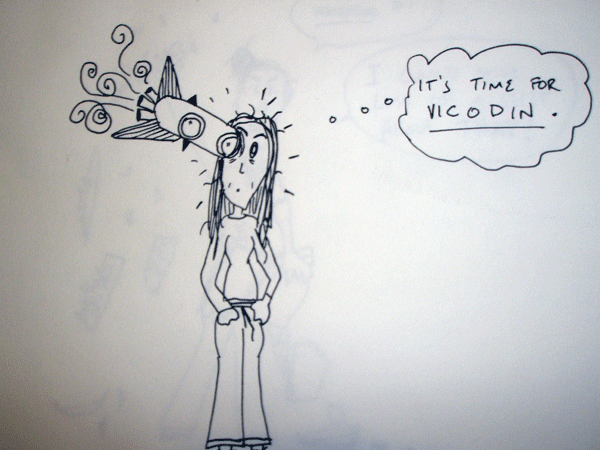
[Image description: A line drawing of a young woman with a quizzical facial expression who has a rocket embedded in the left side of her head. A thought bubble to her right reads, “It’s time for Vicodin.”]
Ink on paper, 2009.
Recently, I read this bizarre article, penned by Judith Warner, in the New York Times–one in a stream of many that detail how excessively awful the current generation of young people (read: young workers) is at putting its collective nose to the grindstone, sucking it up, and generally not acting like a bunch of brats, or something.
Many of us have heard about, or come into contact with, some of these bright young things. They are heralded — or, more commonly, blasted — as naive, entitled, too optimistic, and over-confident. The note of panic begins fairly quickly: They don’t know how to dress professionally! They expect to march into the workplace of their choice and immediately start making a six figure-salary! They think they are perfect! They want praise all of the time! (Does no one who writes this stuff stop to consider that many human beings want praise when they complete a task to the best of their abilities?) They have tattoos, dyed hair, and iPods! EVERYBODY PANIC, because the American workplace is apparently going to be dragged down by Generation Y’s entitlement, narcissism and laziness! This narrative, however, seems to apply mostly to a very specific subset of the population (and even the picture that accompanies the NYT article reinforces this): young, able-bodied, middle to upper-middle class, college-educated white people.
This erases, or conveniently ignores, a hell of a lot of folks who are not young, abled, middle/upper-middle class, and white. It erases young workers who may not have had as many educational opportunities, or who had to take more than the expected four years to finish their degree, or who did not finish school, or go to college at all. It erases people whose parents or family members may not have been quite so “involved” in their education, or in their lives at all. Of course, it also erases young people with disabilities — both those who cannot work, and those who want to work but who may be bumping up against this narrative of the “entitled” Generation Y denizen. Some of us have psychological issues or disabilities that put us completely at odds with the “overly-confident” and “entitled” stereotype that apparently befits the current generation — because we cannot stop worrying despite the fact that we are supposed to be totally optimistic and confident all of the time, thinking that the roads leading to our perfect job will be lined with rainbows and gold.
Some of us have physical disabilities, chronic pain, or chronic illnesses that prevent us from working 40-hour weeks (or more); asking for accommodations or disclosing our condition(s), we fear, may make us look “entitled,” or like we do not want to put in the time necessary to work our way up — even if this is not the case. The fact is that many people, and many young people, with disabilities are already at a tremendous disadvantage when it comes to the labor market and making a living. Not only are many people with disabilities more likely to live in poverty, but they may face hostility, discrimination, and unreasonable demands, both in the workplace and from society at large.
While I am not saying that these over-entitled Generation Y-ers don’t exist (they absolutely do, in my experience), I am struck by the fact that this narrative is so dependent upon erasing or ignoring certain people whose bodies and experiences do not fit the “expected” labor-related attitudes that have been traditionally upheld by American culture. Many of these attitudes, furthermore, rely heavily on binaries: You either work full-time, or you’re lazy. You’re willing to be mistreated in the workplace and do whatever it takes “for the job,” or you’re a wimp. Suck it up, or go home. If you’re not making enough money to live on or are poor, you just aren’t working hard enough. If you ask for “accommodations,” you’re asking for too much — just do your job! You have to work hard to “make it,” and if you don’t work hard enough, it’s your fault. If you don’t like your job or face daily mistreatment, you can always quit and find another one, right? But if you can’t, it’s your fault, and why did you quit that job, anyway?
The message for Generation Y, in general, may be “Get over yourself,” but the message for those who do not fit the characteristics of the “average” Generation Y worker is more severe — and ultimately more dire.
[Cross-posted at FWD]
In a move that I have been resisting for a very long time, I put up a PayPal donation link on this here blog (and also in the sidebar, under the category “Donate, if you feel like it” [scroll down a bit]). This is mostly because I don’t make a lot of extra money, and figured that there are maybe some people out there who might enjoy my writing so much that they feel strangely compelled to donate?
I wrestle a lot with the whole “entitlement” question, and I definitely do not expect or think that people will or “should” give me money; there is a reason that I’ve been doing the blogging thing explicitly for free for a while now—because I enjoy writing. But on the other hand, I could use any extra money, really (for example: I just got a rather hefty and not-totally-expected hospital bill from an ER visit back in April). And if some people get enough out of my writing/ideas/verbosity to want to donate, that’s great. If not–because they can’t afford it or don’t want to donate–that’s okay, too. So if you want to or can donate, I thank you in advance. If not, I totally understand. And if you have any questions or concerns, you may contact me at hamdotblog AT gmail[.]com.
[Cross-posted at Tumblr in a slightly different form.]
Here’s the scoop: Despite the fact that I am sort of a cartoonist and “into” graphic art, I am, sadly, not totally on the up-and-up when it comes to comics and graphic novels! So, I need recommendations from you fine folks for a project that I will be starting on rather soon. I am mostly looking for autobiographical comic/graphic novels, comics/graphic novels having to do with illness or disability, race, and/or gender and sexuality (I prefer non-fiction for these categories), and comics/graphic novels that cover awkward situations in childhood, adolescence, or young adulthood (fictional or not). Also, how-to books (such as Eisner’s Comics and Sequential Art, which I already own and have dog-earred to infinity) are also welcome as suggestions, as I will definitely need inspiration for writing a long-form graphic piece.
Here’s a list of stuff I already have that is in one or more of the above categories: One! Hundred! Demons! (Barry, 2002); Fun Home (Bechdel, 2006); Funny Misshapen Body (Brown, 2002); The Spiral Cage (Davison, 1992); Cancer Made Me a Shallower Person (Engelberg, 2008); Jokes and the Unconscious (Gottleib and DiMassa, 2006) Stitches (Small, 2009), American Born Chinese (Yang, 2006) [thank you Anna for reminding me of this one!].
PLEASE, SUGGEST AWAY!
[Description: A young-looking white woman enters what looks like a fancy lobby and climbs a set of stairs, to soft music. Cut to a closet, where a pair of anthropomorphic orange slip-on shoes peek out of the door. One makes a “quiet” motion to the other. The woman unlocks the door to her apartment, and the shoes open the closet door. A dog looks at them as they come running out of the closet, tripping over some dog toys as they do so. The shoes grab onto the woman’s ankles as she enters the apartment. She sits down, and they remove her high heeled-shoes, then begin to massage her feet. Voiceover: “Meet Croslite, the loyal, loving, good-for-you-technology in every pair of Crocs.” The woman stands up from the couch, and this time her feet are clad in a pair of red flats. She walks into another room as text onscreen reads “Feel the love” and Crocs shoe-styles “rotate” near the text, and the Crocs logo appears below it.]
I can’t be the only one who’s creeped out by this TV ad for Crocs; it has the general aura of one of those ads that’s supposed to be cute but just ends up seeming totally fucking creepy. As comfortable as Crocs are, I do not want to associate my pair (surprise, they are orange!) with scary little shoe-people who are just so excited when I come home that they cannot help but grab onto my ankles, then smile and blink as they massage my feet (which are probably stinky and certainly not that nicely manicured).
Furthermore, I can only imagine what the pitch meeting for this ad must have been like.
So, what are your favorite ad campaigns in which a sense of creepiness (or outright horror) rises from the ashes of cute and/or endearing?
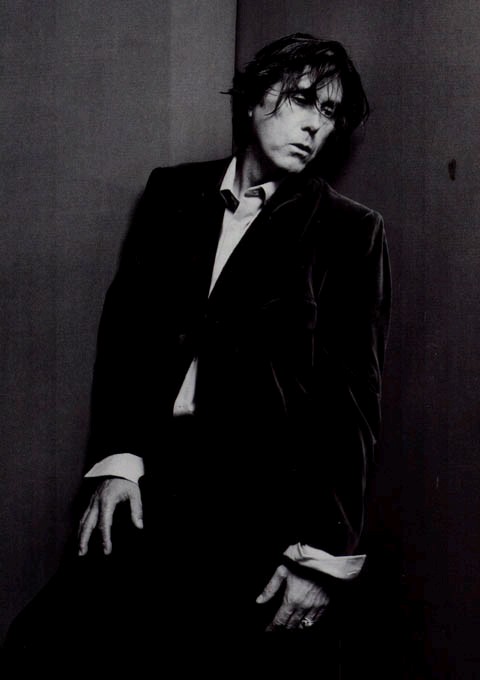
[Image description: A raven-haired man wearing a black velvet suit and white shirt leans against a wall.]
First: LOOK AT THIS STYLISH MAN, OTHERWISE KNOWN AS BRIAN FERRY. He is SO STYLISH. I wish I could be half as stylish as he is. I have a black velvet blazer hiding in my closet, which I have been known to break out when I, too, wish to be stylish in the way that only a rocker from the 1970s can be, but have not yet found a pair of velvet pants to complete the look.
Second: While writing some of this, I realized that it might be helpful to have some actual examples of precisely what I mean when I say that Roxy Music is an amazing band, so here is an entirely separate post in which I share some of my favorite songs of theirs.
My favorite bit of music trivia ever is Roxy Music-related**: band member Brian Eno did not know how to play the keyboard before he joined Roxy Music. For reasons as to why this is completely amazing, look no further than Wikipedia’s page on Eno. He has gone on to have a lengthy, influential and successful music career even though he once joined a band, as its keyboard player, without knowing how to play that instrument.
I love Roxy Music and Brian Ferry not just for the music, but because they remind me that I can have an impact with my own work that, though it will most definitely not appeal to everyone, may have some sort of impact on someone. I am an indescribably crappy guitar player (mostly because fibromyalgia-related hand and arm pain prevent me from banging out anything other than a few chords). I am not a great singer. I will never be Ani DiFranco. I will never be Patti Smith, nor PJ Harvey, nor Tori Amos, nor Alanis Morissette, nor Beth Ditto, nor Me’shell Ndegeocello. These people are all talented, I am a fan of each of them, and their success is well-deserved; however, I will probably never approach that level of success, as the work I do is not in the getting-up-onstage-and-singing-in-front-of-people field.
Hell, I have a blog. Which I write on, and which I take extremely seriously. I write and draw a lot of stuff on various topics — most of this work has not been published (yet), or shown to other people (yet), and almost none of it has been the center of controversy or much attention (barring my work on that one thing).
If I may be philosophical and mildly tedious for a minute: Roxy Music and Bryan Ferry’s work remind(s) me is that there is a whole lot of good in just being whatever you are and, simultaneously, not knowing what you are doing all of the time (like Brian Eno and the whole not-knowing-how-to-play-the-keyboard-thing), and that it is okay to be “okay” at something as long as you love it. You do not have to be the greatest and most original band/singer ever to make an impact.
And, paradoxically, that is part of what makes Roxy Music such a great band.
Your weirdness, your originality, and your style do not have to be constantly calculated down to the very millisecond, or planned out in infintesimal detail, or boasted about on Twitter every ten seconds. There is room for those things to just develop and grow by themselves, if you let them. I think many segments of the entertainment industry–and, unfortunately, a lot of “creative” types–tend to forget this. Of course, part of that is how the “business” works, but for those of us who aren’t in the industry (but who are still in the age of Twitter, MySpace, and Facebook wall updates with instantly-emailed notifications), this can be difficult to remember.
But, it is worth remembering.
**[That is, other than the rumor that Tori Amos has $100,000 worth of “hand insurance” in case her hands are ever irrevocably injured. I am sure there is a source for this somewhere on the internet, but I haven’t quite found it yet. If any Tori fans have a citation for said factoid that proves or disproves this rumor, please feel free to leave it in the comments so that I can continue being lazy in regards to internet research.]
 Anna Hamilton | Writer